


.avif)
)%20(1920%C2%A0%C3%97%C2%A0900%C2%A0px).avif)
What you’ll find in this guide:
- LinkedIn: a large-scale professional knowledge base
- An increasingly central source in AI-generated answers
- Why LinkedIn is heavily leveraged by LLMs
- What this changes for brands and experts
- A different selection logic from social media
- Conclusion
For years, online visibility was based on a simple principle: ranking well on Google.
But with the rise of large language models (LLMs) like ChatGPT and AI-generated responses from Google, a profound transformation is underway.
Users are no longer just looking for links, they expect answers.
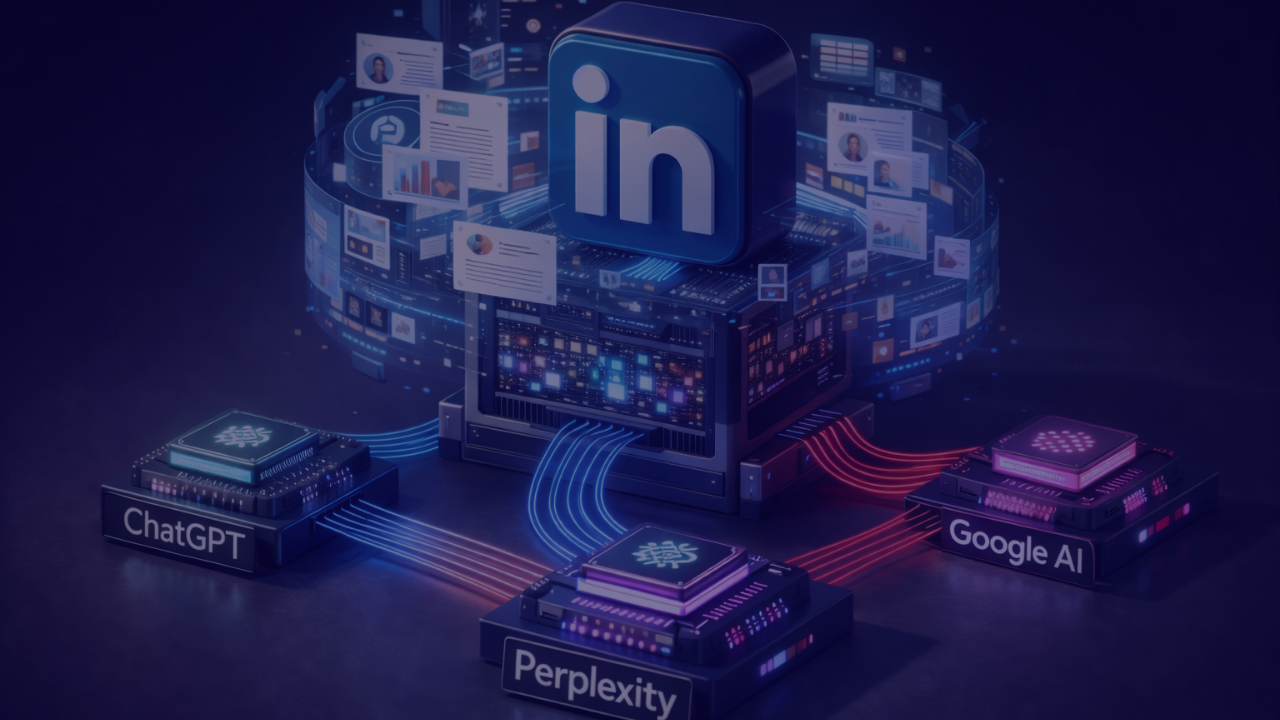
And to generate those answers, AI systems rely on multiple sources. Among them, one platform is becoming increasingly important: LinkedIn.
LinkedIn: a large-scale professional knowledge base
LinkedIn is no longer just a social network. It has become a massive infrastructure for producing professional content.
According to Le Blog du Modérateur, the platform now has over one billion members worldwide, across more than 200 countries, including 37 million in France in 2026.
This scale fundamentally changes the nature of the platform.
Every day, millions of posts are published: field experience feedback, industry analyses, tool breakdowns, and expert opinions.
We are no longer talking about a network but about a living knowledge base, continuously updated.
In this context, it is only natural that AI models rely on this type of content.
From a browsing web to a synthesis web
We are moving from a web of navigation (clicking links) to a web of synthesis (getting answers).
In this new model, content is no longer just consumed; it is ingested, reformulated, and redistributed by AI systems.
The real battle is no longer about being visible.
It is about becoming a source.
LinkedIn: an increasingly central source in AI-generated answers
Recent data confirms a rapid acceleration of LinkedIn’s role within the LLM ecosystem.
According to a study by SEMrush, relayed by Siècle Digital, LinkedIn is now the second most cited source by generative AI, just behind Reddit, across tools like ChatGPT, Google AI, and Perplexity AI.
More importantly, the growth is extremely fast.
Between late 2025 and early 2026, LinkedIn moved from 11th to 5th place among the most cited domains by ChatGPT, with citation frequency more than doubling.
LinkedIn is particularly present in responses related to professional queries, reinforcing its importance in B2B contexts.
In other words, this is no longer an emerging trend; it is a structural shift in how information is accessed.

Why LinkedIn is heavily leveraged by LLMs
If LinkedIn plays such a central role in AI-generated responses, it is largely due to the nature of its content.
1. A high concentration of expert content
Unlike other platforms, LinkedIn is built on professional content produced by experts, consultants, and executives.
This content is contextualized, structured, and aligned with real-world challenges exactly what language models need.
2. Credible and human-centered content
Another key feature of LinkedIn is that content is tied to identifiable individuals with clear expertise and professional backgrounds. This significantly enhances credibility.
This aligns with Google’s E-E-A-T framework (Experience, Expertise, Authoritativeness, Trustworthiness), which values content produced by legitimate authors.
Even though LLMs operate differently from search engines, they tend to favor content with similar credibility signals.
3. Constantly updated information
LinkedIn operates as a continuous information flow, with content being published and refreshed constantly.
This provides access to up-to-date insights on fast-moving topics such as marketing, technology, and AI.
As models increasingly integrate fresh data, this ability to reflect current practices makes LinkedIn content especially valuable. This dynamic is already visible in practice.
Example
Take a simple query: "How to structure an ABM strategy in B2B?"
Today, AI systems like ChatGPT or Perplexity do not rely solely on traditional blog articles.
They can also draw from content published on LinkedIn, especially detailed posts or articles written by experts.
A consultant publishing structured content with clear steps, practical examples, and real-world insights increases the likelihood of having their ideas reused in AI-generated responses.
This is confirmed by SEMrush data, which shows that LinkedIn is now among the most frequently used sources for professional queries, particularly in marketing and strategy.
As a result, content is no longer just consumed on the platform; it is reinterpreted and distributed across other environments, often without requiring users to click on the original source.
What this changes for brands and experts
This evolution doesn’t just change tools it changes the rules.
First, traffic becomes less central. A 2026 study by the SEO agency Eight Oh Two found that 37% of users now begin their searches with AI tools rather than traditional search engines.
Second, visibility is shifting. Models like ChatGPT and Perplexity rely on a limited number of trusted sources. In this context, LinkedIn is becoming a key player.
Third, authority is becoming more personal. Nearly 60% of LinkedIn content cited by AI comes from individual creators rather than company pages (Averi).
Personal expertise is becoming a major visibility driver.
Not all LinkedIn content is equal
While LinkedIn is widely used by AI, not all formats perform equally.
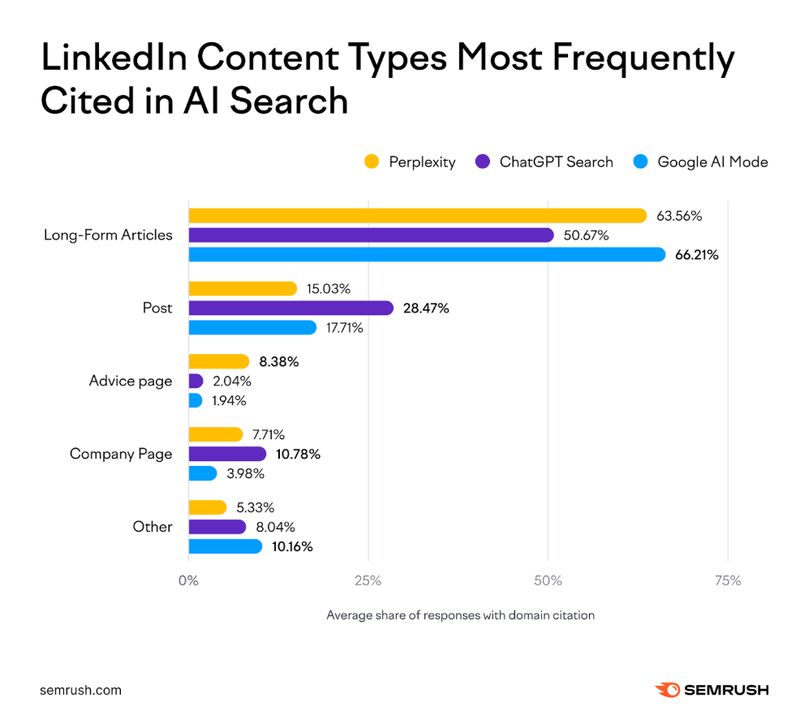
SEMrush data reveals a clear hierarchy:
- Long-form articles (including LinkedIn Pulse) dominate, representing 50% to 66% of cited content
- Structured, educational, expert-driven content performs best
- Content between 500 and 2,000 words accounts for up to 77% of citations
Short posts remain present but secondary, accounting for 15% to 28%.
Interestingly, AI models do not necessarily prioritize viral content. Instead, they favor clarity, relevance, and informational value over popularity.
A different selection logic from social media
This shift highlights a fundamental difference in algorithms.
On LinkedIn, visibility has historically been driven by engagement, virality, and reach.
But AI models operate differently. They prioritize:
- semantic relevance
- information quality
- the ability to directly answer a question
Studies also show that AI-generated answers strongly reflect the meaning of LinkedIn content, with high semantic similarity.
AI systems don’t just cite LinkedIn — they use it to structure their responses.
Conclusion
LinkedIn is changing in nature. From a professional social network, it is becoming a core informational layer used by AI systems.
For B2B brands and experts, the challenge is no longer just to publish for visibility but to publish in a way that allows content to be understood, reused, and integrated into AI-generated answers.
In a world where answers are generated by AI, the most valuable content is the content that becomes a source. Understanding these shifts is the first step.
Integrating them into your strategy is another.
We support B2B companies in adapting their content strategies to the era of generative AI.
Schedule an appointment to speak with our team: https://www.lesanneesfolles.co/#contactbottom
And to stay up to date with our latest insights, feel free to follow us on LinkedIn.



.png)


.avif)
