
.jpg)


.avif)
)%20(1920%C2%A0%C3%97%C2%A0900%C2%A0px).avif)
What you’ll find in this guide
- Why Repurposing Your Podcast Has Become Essential
- What Content Can You Create from a Podcast Episode?
- Client Case Study: Ayming and the La Voix des RH Podcast
- How Artificial Intelligence Speeds Up the Process
- Building a True Content Engine
- Conclusion
Launching a B2B podcast requires a significant investment of time, expertise, and resources. Yet many companies still make the same mistake: they publish an episode, share it once or twice on social media, and immediately move on to the next one.
This approach significantly limits the podcast's return on investment.
Today, a podcast episode should no longer be viewed as a standalone piece of content, but as valuable raw material. A single 30- to 45-minute conversation can be transformed into dozens of content assets tailored to different channels, audiences, and marketing objectives.
The podcast then becomes the starting point of a comprehensive and sustainable content strategy.
Why Repurposing Your Podcast Has Become Essential
Content consumption habits have changed dramatically. Some professionals prefer listening to podcasts during their commute, while others would rather read a blog article, a newsletter, or a LinkedIn post.
For B2B companies, the challenge is no longer simply producing content but making it accessible through multiple formats.
This approach is becoming increasingly relevant as podcasting continues to grow in popularity. According to Fame, more than 584 million people worldwide listen to podcasts today, and that number continues to increase every year.
In addition, research highlighted by Omniscient Digital shows that 90% of companies investing in a branded podcast are satisfied with the results they achieve.
These figures demonstrate that podcasting has become a powerful lever for visibility, brand awareness, and thought leadership.
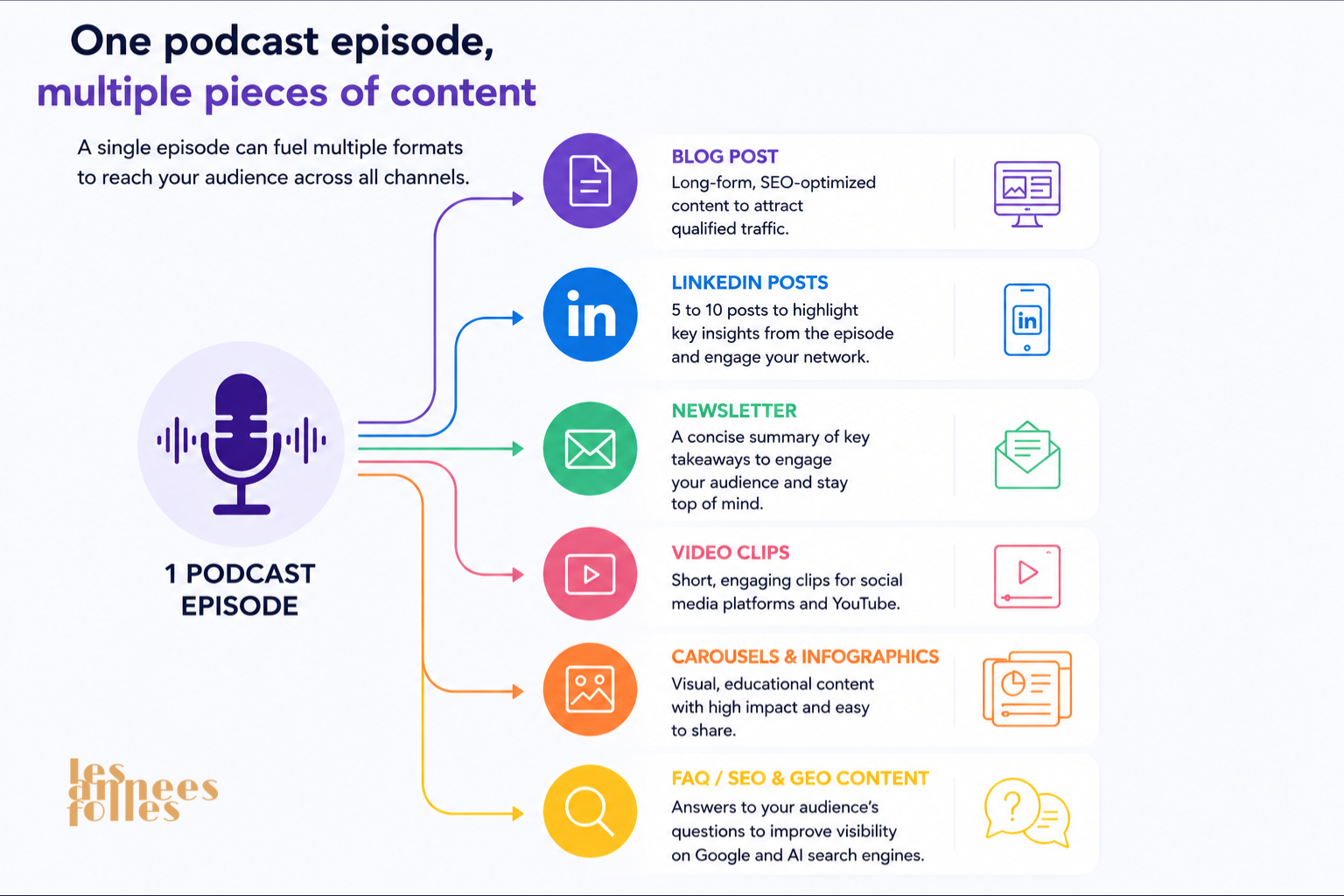
What Content Can You Create from a Podcast Episode?
A single podcast episode often contains enough insights, examples, and expertise to fuel several weeks of communication.
LinkedIn Posts
Every key idea or memorable quote can be transformed into a LinkedIn post.
A 40-minute episode can easily generate five to ten different posts, each highlighting a specific angle of the conversation.
Blog Articles
Podcast transcripts provide an excellent foundation for creating SEO-optimized blog content.
This approach improves search engine visibility while making the content accessible to audiences who prefer reading over listening.
Newsletters
Key takeaways from an episode can be summarized and shared through a newsletter.
This format helps maintain regular contact with your audience while reinforcing the expertise showcased in the podcast.
Video Clips
The most impactful moments can be repurposed into short-form videos suitable for LinkedIn, YouTube Shorts, or other social platforms.
These formats often play a crucial role in helping new audiences discover the podcast.
Carousels and Infographics
Key insights can also be condensed into LinkedIn carousels or infographics, formats that are highly appreciated for their educational value and shareability.
FAQ Pages and SEO/GEO Content
Every question discussed during the podcast can become a standalone piece of content addressing a specific audience challenge. These assets not only improve search engine rankings but also increase visibility within generative AI platforms such as ChatGPT, Gemini, and Perplexity.
By transforming guest insights into articles, FAQs, and practical guides, brands create more opportunities to be discovered while maximizing the value of the expertise shared in their podcast. This contributes to both traditional SEO strategies and GEO (Generative Engine Optimization) initiatives.
Client Case Study: Ayming and the "La Voix des RH" Podcast
Since 2023, Les Années Folles has been supporting Ayming in the production and distribution of its branded podcast, La Voix des RH.
Over three years, the podcast has surpassed 40,000 cumulative listens and released 45 episodes featuring leading HR executives and business leaders from major organizations such as Orange, Air France-KLM, and Etam.
The podcast also benefits from the visibility of two well-known HR influencers: Florence Bernier (70,000 LinkedIn followers) and Vincent Hagenbourger (58,000 followers), who help amplify each episode's reach among a highly qualified audience.
The results go far beyond audience metrics. While each episode generates between 600 and 1,000 listens, the podcast has become a genuine business development and brand awareness tool. It enables Ayming to democratize its expertise, engage directly with key decision-makers, and, in some cases, turn guest relationships into commercial opportunities.
Each episode also fuels an entire ecosystem of content, including influencer posts, LinkedIn publications, newsletters, video clips, and re-engagement campaigns.
The podcast is therefore much more than an audio format—it has become an editorial engine supporting visibility, credibility, and business growth.
How Artificial Intelligence Speeds Up the Process
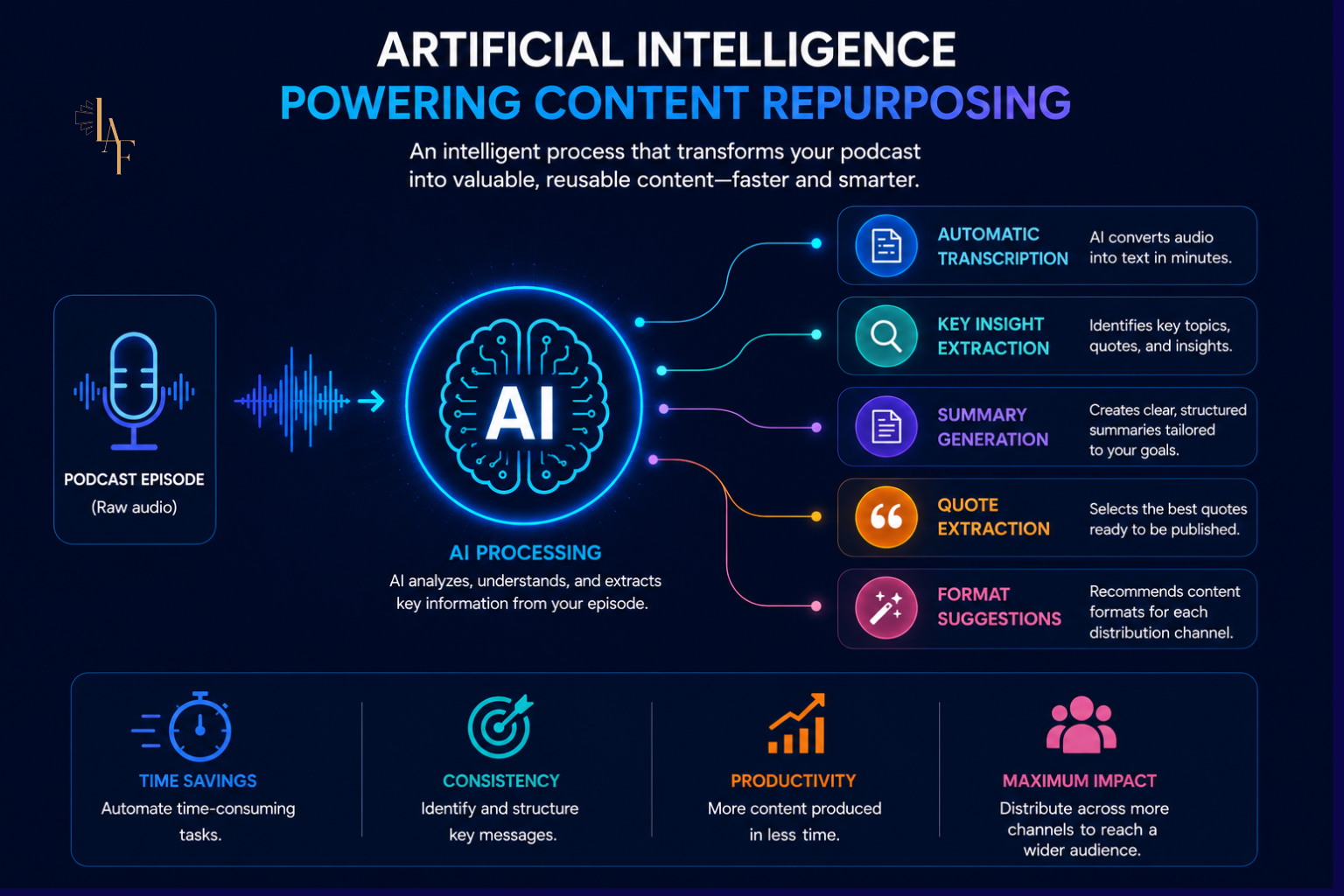
Artificial intelligence now plays a central role in content repurposing strategies. Tasks that previously required hours of manual work can now be partially automated through AI-powered tools.
Starting from a single recording, teams can generate transcripts, identify the most relevant moments, extract memorable quotes, and produce initial summaries of each episode. These assets can then serve as the foundation for blog articles, newsletters, social media posts, and more.
AI therefore represents a significant productivity gain for marketing teams. However, it should be viewed as an efficiency tool rather than a replacement for human expertise. Selecting key messages, adapting content for different audiences, and maintaining editorial consistency remain essential to ensuring content quality.
When used strategically, AI enables organizations to transform podcasts into a wide range of coherent content assets more quickly while freeing up time for higher-value activities.
Building a True Content Engine
Turning a podcast into a content engine requires a clear methodology.
Once an episode is published, a structured process helps extract its full value. It usually starts with transcription and the identification of key insights. Teams can then create video clips, write LinkedIn posts, produce blog articles, and prepare newsletters. Finally, content distribution can be scheduled over several weeks to maximize reach and impact.
This organization extends the lifespan of each episode, allowing it to generate value for weeks or even months after publication.
Conclusion
B2B podcasts are no longer just audio formats. They have become one of the richest sources of content available to businesses today.
By transforming each episode into blog articles, LinkedIn posts, newsletters, videos, and SEO resources, brands maximize their return on investment while increasing visibility among their target audiences.
The question is no longer whether you should create more content, but how effectively you can leverage the content you already have.
Looking to get more value from your podcast and build an effective content repurposing strategy?
🚀 Ready to go further? Grab our free Influence Marketing eBook and unlock more powerful growth tactics.



.png)


.avif)
