.png)


.avif)
)%20(1920%C2%A0%C3%97%C2%A0900%C2%A0px).avif)
Most B2B influence strategies were designed for an environment that no longer exists.
Decision-makers no longer discover brands the same way. Expert creators are playing an increasingly important role in professional conversations. Platforms are evolving. And artificial intelligence is gradually transforming how companies are discovered, evaluated, and recommended.
Yet many organizations continue to apply the same playbook: more content, more reach, more impressions.
The problem is not that these tactics no longer work.
The problem is that they are no longer enough to create influence.
At Les Années Folles, we witness this transformation every day. Through more than 350 B2B campaigns and over 500 million views generated, we see new rules emerging that are reshaping how brands build visibility, credibility, and brand preference.
B2B influence is entering a new phase.
Here are the five major transformations that, in our view, will redefine the market in 2026.
The 5 Transformations Redefining B2B Influence in 2026
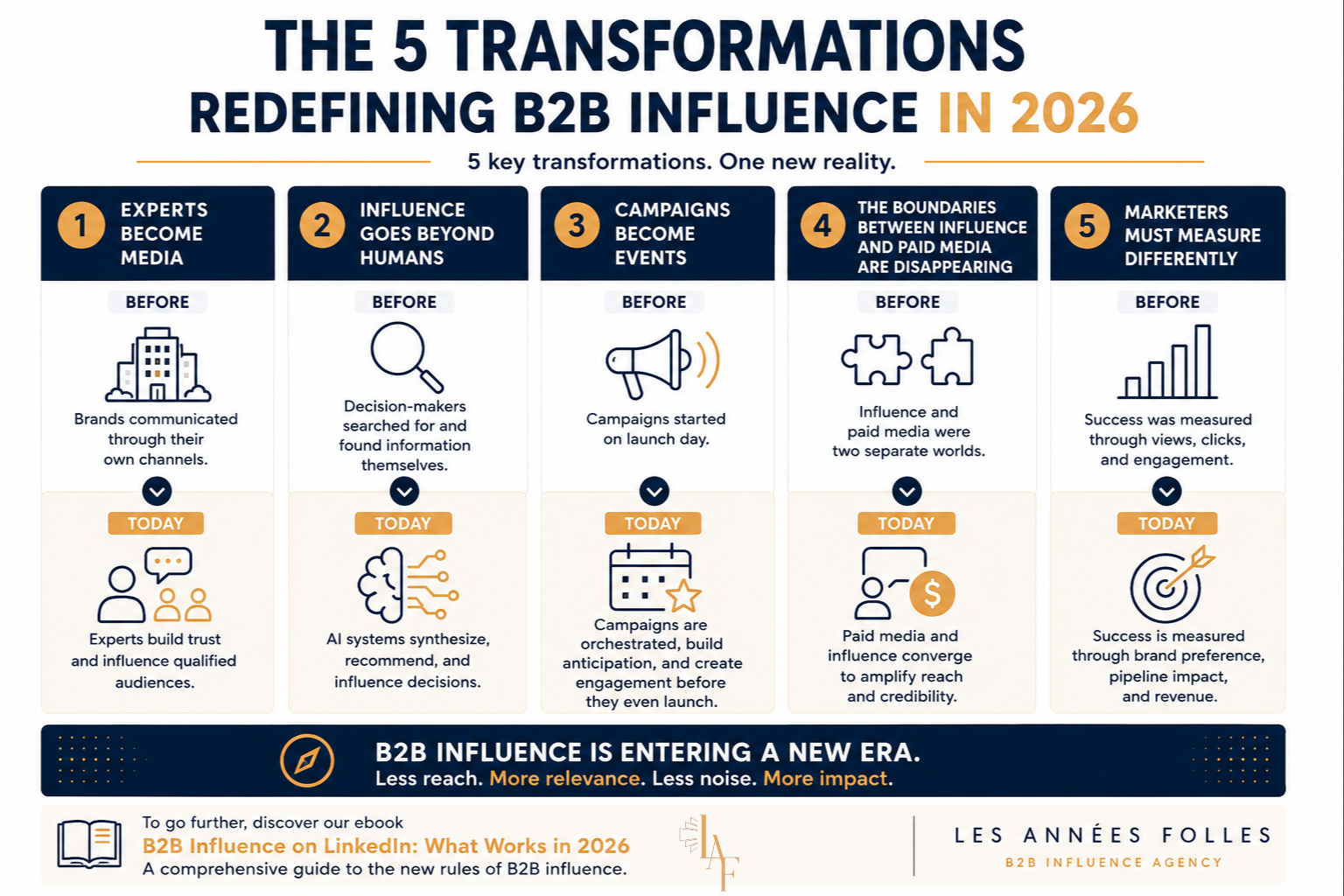
1. Experts Are Becoming Media
For years, brands focused their efforts on their own communication channels. Today, attention is shifting toward individuals.
Executives, consultants, entrepreneurs, industry specialists, and B2B creators are building engaged audiences around their expertise. Their influence depends less on follower count and more on their ability to inspire trust within a qualified community.
This evolution is part of a broader shift often referred to as the trust economy. In an environment saturated with messages, decision-makers pay greater attention to content shared by identifiable individuals than to traditional corporate communications.
For brands, the challenge is no longer simply to be visible.
It is to be associated with the right voices.
2. Influence No Longer Stops with Humans
The rise of large language models such as ChatGPT, Perplexity, and Gemini has introduced a new layer to the influence ecosystem.
Content is no longer created solely to persuade a direct audience. It now helps shape the answers generated by artificial intelligence systems.
In other words, expert content can influence a decision-maker even if that person has never read it directly.
Visibility is no longer limited to social feeds and search engines. It increasingly depends on a brand's ability to produce content that is credible, structured, and valuable enough to be referenced by AI systems.
Human influence is now fueling algorithmic influence.
3. Campaigns Are Becoming Events
The most successful campaigns no longer begin when the first piece of content is published.
They begin much earlier.
In an environment where attention is scarce, visibility alone is no longer enough. Brands must create anticipation.
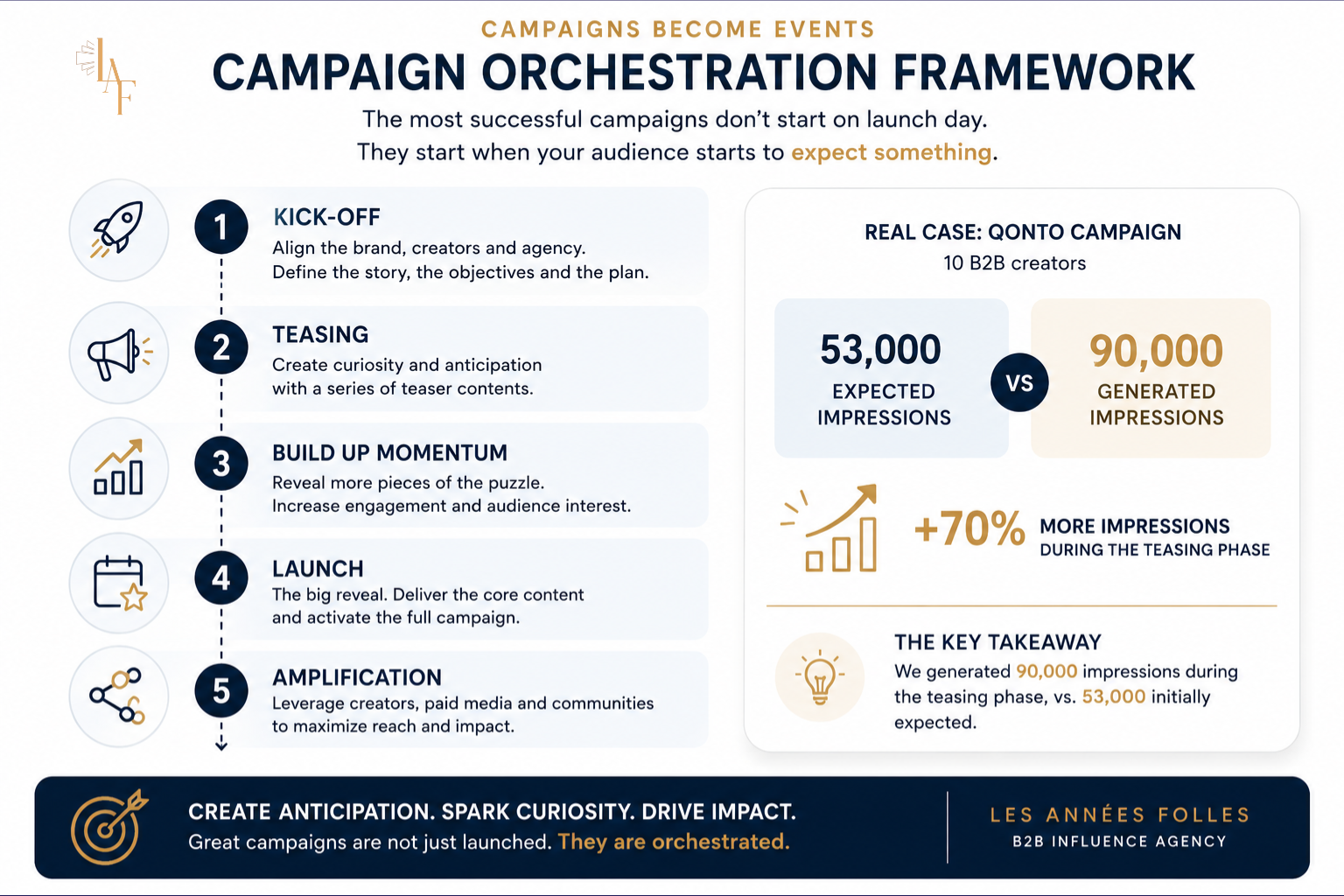
This orchestration can take many forms: kick-off sessions bringing together the brand, creators, and agency, teaser content, countdowns, progressive announcements, and initiatives designed to spark curiosity before launch.
At Les Années Folles, we implemented this approach as part of a campaign conducted with Qonto and 10 B2B creators.
Over a two-week period, various pre-launch assets were deployed to gradually build interest and anticipation around the campaign. The result: more than 90,000 impressions generated during the teasing phase, compared to 53,000 initially expected.
The lesson is simple: the best campaigns do not start when they launch.
They start when audiences begin looking forward to them.
4. The Boundaries Between Influence and Paid Media Are Disappearing
For years, influence and paid media were treated as separate disciplines.
Today, they are converging.
One of the clearest examples is LinkedIn's Thought Leader Ads.
This format allows brands to sponsor content published by executives, employees, or industry experts instead of promoting corporate content directly.
The result is particularly powerful in B2B: the reach of paid media combines with the credibility of a human voice.
This shift reflects a broader reality: the best advertisements no longer look like advertisements.
5. Marketers Must Learn to Measure Differently
Impressions, clicks, and engagement rates remain useful.
But they are no longer enough to assess the true impact of an influence strategy.
Marketing leaders increasingly want to understand how influence contributes to brand preference, pipeline generation, and revenue.
New metrics are emerging: Share of Voice, Pipeline Influence, Brand Authority, AI Discoverability, and Dark Social analysis.
One reality is becoming clear: reaching 100 highly qualified decision-makers can create more value than reaching 100,000 people with little interest in your solution.
The question is no longer simply how many people saw a piece of content.
The question is who saw it, what it changed, and what it generated.
What's Next?
These five transformations represent only part of the changes currently reshaping B2B influence.
In our new ebook, B2B Influence on LinkedIn: What Works in 2026, we take a deeper look at the new rules of the market, the impact of LLMs on brand visibility, emerging LinkedIn formats, the KPIs that truly matter, and the strategies that turn influence into a growth driver.
👉 Download the ebook soon to discover the full analysis.


.png)


.avif)
