



.avif)
)%20(1920%C2%A0%C3%97%C2%A0900%C2%A0px).avif)
The lines between tech, content, and growth continue to blur. In the past, companies' digital presence was seen as mere sales support, treated like a traditional advertising channel. Today, having an exceptional product is no longer enough to capture your market's interest. To exist in 2026, Chief Marketing Officers (CMOs) must undergo a radical shift in mindset: they must stop thinking solely as marketers and start thinking like media publishers.
Welcome to the era of brands turned media.
Here is what you will find in this article
- The end of "push" advertising and the war for attention
- Building an "Owned Audience" to break algorithmic dependency
- The 3 essential pillars of the brand-media
- The organizational impact: reinventing the marketing department
The End of "Push" Advertising and the War for Attention
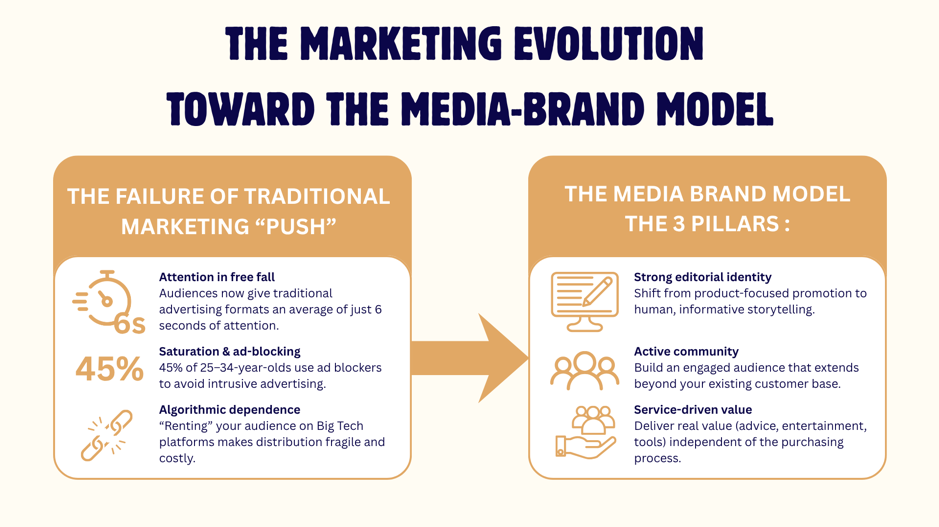
Traditional vertical "push" communication is currently facing a massive and irreversible rejection by the public. On average, an internet user's advertising attention span no longer exceeds 6 seconds, and more than 45% of 25-34 year-olds browse with an active adblocker.
To explore this disillusionment with advertising further, you can consult our analysis: Do B2B decision-makers still buy under the influence of advertising?
At the same time, the buying experience has become considerably more complex: a consumer now consults an average of 18 distinct sources of information before making a purchase decision. This purchasing journey has thus transformed into a true content journey. Each touchpoint must therefore deliver immediate editorial value (educational, informative, or entertaining) to successfully stand out in a digital landscape saturated with ads.
Building an "Owned Audience" to Break Algorithmic Dependency
The majority of traditional content strategies rely on third-party platforms that brands do not own (search engines, Big Tech social networks). A single algorithm adjustment can wipe out months of organic acquisition efforts. This is why owning your captive audience (owned audience) is currently the strongest shield against these unpredictable changes.
To anticipate these market dynamics, discover the 5 shifts redefining B2B influence in 2026.
This reality explains the explosion of media acquisitions by tech giants in recent years. HubSpot bought the business media outlet The Hustle, Pendo acquired the product manager community Mind the Product, Semrush bought Backlinko, and Stripe acquired Indie Hackers. Owning a media arm makes it possible to integrate the brand into the daily news consumption habits of decision-makers, thereby drastically reducing customer acquisition costs (CAC) while securing valuable first-party data.
The 3 Essential Pillars of the Brand-Media
Becoming a media outlet is not simply about publishing a massive volume of blog posts to feed your sales funnel.
An authentic media brand relies on three key dimensions: a strong editorial line, an active community, and a service utility that goes far beyond product sales.
Iconic brands like Red Bull or GoPro understood this long ago. They behave as publishers, focusing on the storytelling of an adventurous lifestyle rather than their products, creating an almost cult-like sense of belonging.
In the professional world, this model proves to be just as powerful. During its relaunch, the Alpine brand designed an entire ecosystem centered around embodying its automotive passion and brand content, without traditional media buys, selling out its entire launch series in just 72 hours.
Your content must address decision-makers just like consumers, prioritizing authentic human expertise and the sharing of raw knowledge early in the sales cycle.
On this topic, we break down how to adapt your content for the modern era in our article: How LLMs Are Transforming B2B Content Strategies.
The Organizational Impact: Reinventing the Marketing Department
The transition to a brand-media model requires a deep rethinking of your internal structures. The days when digital teams were tasked with simply "feeding the ad beast" at the end of the production chain are gone. Traditional marketing roles must evolve into media directors, editors-in-chief, and traffic managers.
Company rituals are now organized around editorial boards, rigorous fact-checking routines, and an absolute commitment to transparency. In the era of hyper-transparency, every step of your value chain, from research and development to your internal logistics processes, turns into an opportunity for authentic storytelling to assert the brand's commitments to its audience.
To initiate this restructuring, you can follow our advice in our guide: How to Build a Powerful B2B Influence Strategy from Scratch.
From Brand Awareness to Sustainable Business
In this new paradigm, the company's product is no longer the sole end in itself, but becomes the means to fund an opinion-leading, engaged media channel that champions the organization's values and worldview. Brands that build these editorial ecosystems will possess an audience moat that is impossible to copy.
Stop being the advertising noise your customers try to filter out. Become the go-to source of information and expertise in your market.
Ready to turn your brand into a true reference media outlet?
Download our free Playbook: B2B Influence on LinkedIn in 2026: What Actually Works, to learn how to leverage credible industry thought leaders to carry your brand's editorial voice and boost your business opportunities.



.png)


.avif)
